In short
- A short meeting is a scheduled meeting with a fixed time, a small agenda and a hard stop, usually 15 minutes or less.
- The daily stand-up is the most common example. The Agile Alliance describes it as timeboxed to a maximum of 15 minutes.
- To keep it short: same time every day, one round of updates, problems go to a “parking lot”, and follow-ups happen right after, between the people involved.
Short meeting or quick meeting?
The two terms get mixed up, but they solve different problems. A quick meeting is an unscheduled conversation between two or three people about one question. It happens when the question appears, and we cover it in quick meeting: what it is and 5 rules. A short meeting is on the calendar: it repeats, involves the team and has a timebox. The daily stand-up, the weekly sync and the morning huddle are short meetings.
This article is about the second kind: how to keep a recurring meeting short.
Why the daily stand-up drifts on remote teams
The format is old and well documented. The Agile Alliance glossary describes the daily meeting as a moment when each person briefly shares what they finished and what is blocking them, normally timeboxed to a maximum of 15 minutes. Any topic that turns into a discussion is cut short and moved to a “parking lot” for later.
Remotely, a few things push it past that limit:
- The start slips. Someone cannot find the link, someone else is still in another call, and five minutes are gone.
- It becomes the only time people talk. When the team has no other place to meet, everything gets brought to the stand-up.
- Problem-solving takes over. Two people start fixing a bug while eight others wait.
- It reports to the manager. Updates go to one person instead of to the team, and they get longer.
A 15-minute script for a remote daily stand-up
| Minute | What happens |
|---|---|
| 0–1 | Start on time, even if someone is missing. One sentence on today’s focus, if any. |
| 1–11 | One round. Each person: what I finished, what I am doing today, what is blocking me. About one minute each. |
| 11–13 | Read the parking lot: list the topics that came up, and who needs to talk about each one. |
| 13–15 | Confirm the follow-ups and close. Nobody stays “just to discuss one thing”. |
For a team of 10 or more, one minute per person no longer fits. Split the stand-up by sub-team, or move updates to a written message and use the meeting only for blockers.
7 rules that keep a short meeting short
- 1Same time, same place. Organizational psychologist Steven Rogelberg, writing for TED Ideas, describes the huddle as a 10- or 15-minute meeting that usually happens at the same time and in the same place.
- 2Start and end on time. Rogelberg also warns that running over is a real problem: it disrupts what comes next for everyone.
- 3Updates are for the team, not the manager. Talk to your teammates. The leader is one of them.
- 4One round, no debate. If a topic needs discussion, it goes to the parking lot.
- 5Follow-ups happen right after, with only who is needed. In the same TED piece, Rogelberg notes that the walk back from a huddle is often a good moment for those conversations.
- 6Cameras optional. Voice is enough for a stand-up. Video is there when it helps.
- 7Write down what was decided. One line in chat for each follow-up, so the people who missed it can catch up.
For more patterns, Jason Yip’s article It’s Not Just Standing Up, on martinfowler.com, is a classic reference.
What to move out of the daily stand-up
| It is in the stand-up today | Better place |
|---|---|
| Detailed project status | A written update in chat |
| Debugging a problem | A quick conversation between the two people involved, right after |
| Decisions involving other teams | A separate short meeting with an agenda |
| Announcements | The general channel |
| Small talk and team connection | Spontaneous conversations during the day |
That last row matters. When the team has nowhere else to be together, the stand-up has to carry the social part too, and it stops being short.
Running the daily stand-up in a virtual office
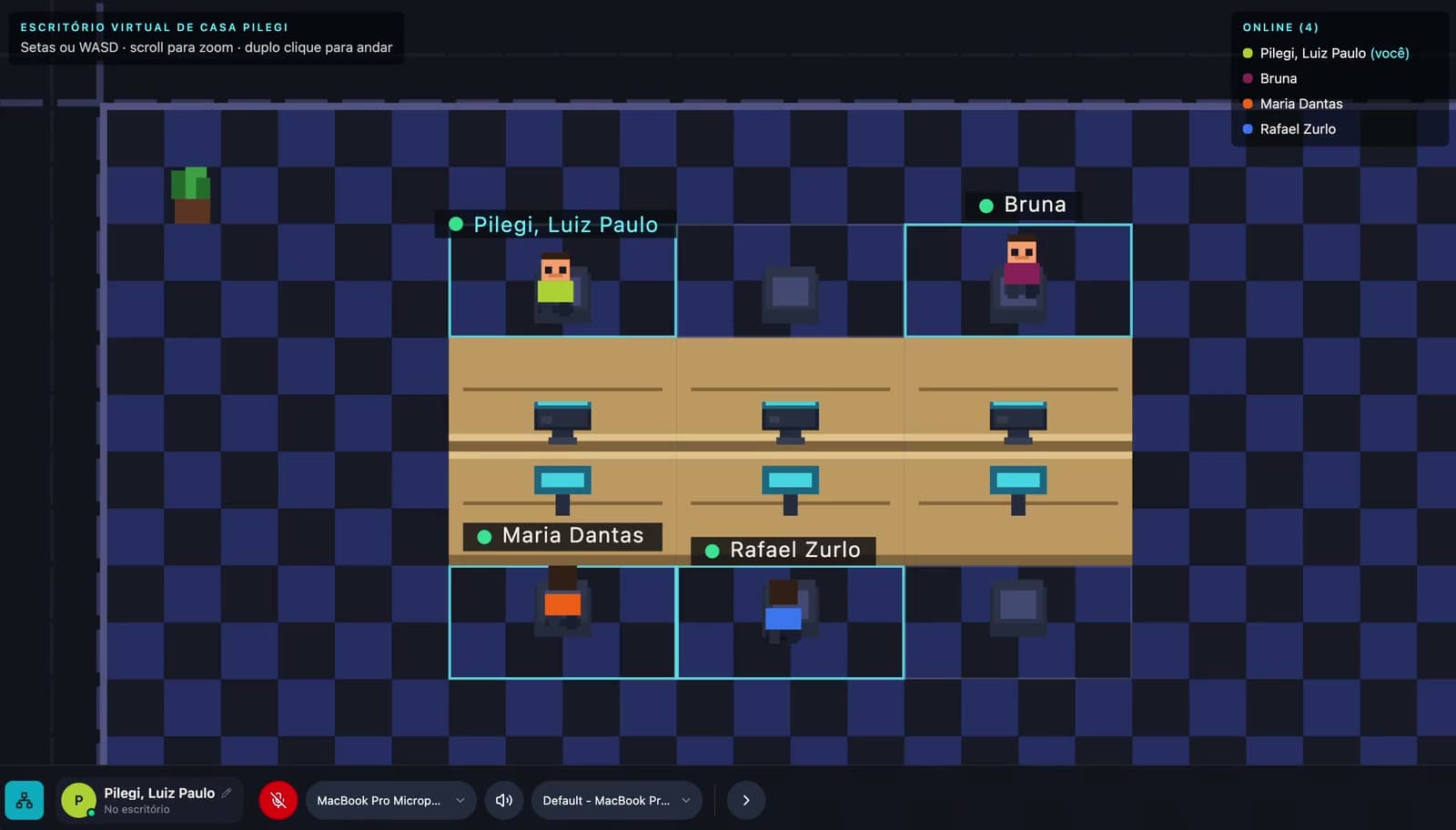
In a virtual office, the stand-up stops being a link to find. In Capitown, the map has a meeting room: everyone who walks in joins the same call, with camera and screen sharing when needed. Before it starts, you can see who is already at their desk. When it ends, people walk back to their desks, and parking-lot topics become short conversations at a teammate’s desk instead of new meetings.
Status helps protect the rest of the day. After the stand-up, anyone who needs to focus can turn on Do not disturb: they stay visible on the map, but nobody pulls them into a call. See how to agree on that in status in remote work, and how the room replaces links in how to reduce Zoom and Meet meetings.
How to tell whether it worked
For two weeks, write down how long each stand-up actually lasted and how many topics went to the parking lot. Then ask the team:
- Did the stand-up end on time most days?
- Were parking-lot topics solved the same day?
- Did anyone feel they needed a separate meeting to catch up?
If the answers are good, keep the format. If not, adjust one thing at a time, such as the order of speakers, written updates or splitting by sub-team.
Conclusion
A short meeting stays short when it has a fixed time, one round of updates and a clear place for everything else. On a remote team, the hardest part is the “everything else”: without a place to talk during the day, the stand-up absorbs it all. Give the team that place, and 15 minutes becomes enough. To try it with a small group, follow how to adopt a virtual office in 14 days.
Frequently asked questions
What is a short meeting?
A short meeting is a scheduled meeting with a fixed time, a small agenda and a hard stop, usually 15 minutes or less. The daily stand-up is the most common example.
How long should a daily stand-up last?
The Agile Alliance describes the daily meeting as timeboxed to a maximum of 15 minutes, with adjustments for larger teams.
What is the difference between a short meeting and a quick meeting?
A short meeting is scheduled and recurring, with a timebox. A quick meeting is an unscheduled conversation between two or three people about one question, and it happens when the question appears.
What should not be discussed in a daily stand-up?
Detailed status, debugging and decisions involving other teams. They go to a parking lot and are handled right after, only with the people involved.
How do I run a daily stand-up with a remote team?
Keep the same time every day, start on time, do one round of updates, move discussions to a parking lot and record follow-ups in chat. In a virtual office, the stand-up can happen in the map’s meeting room, without a link.
Do cameras need to be on in a remote stand-up?
No. Voice is enough for most stand-ups. Turn on the camera when you need to show something or when the team prefers it.